What this covers
On 4 August the Financial Times published a video in which its consumer editor worked through how income tax, National Insurance and student loan repayments interact. The headline number was that graduates in one income band keep 29p of each additional pound earned. A guest described this as a "tax on ambition".
The 29p applies to earnings between 100,000 and 125,140 pounds, where the personal allowance is withdrawn on top of higher-rate tax, National Insurance and the 9% loan deduction. The combined marginal rate in that band is 71%. Below it the picture is different, and most graduates never enter it.
This piece sets out the full repayment mechanics for a 2026 starter, then sets them against a second route that families are less likely to have costed: an English-taught degree at a European public university, paid as you go.
Scope: fees and loan terms here are for England. Scotland, Wales and Northern Ireland run separate systems. Much of the current commentary concerns Plan 2 borrowers from the 2012 to 2022 cohorts. Anyone starting in 2026 is on Plan 5, which is what this piece describes.
What the loan does
Tuition for English students starting in 2026 is capped at 9,790 pounds a year, rising to 10,050 pounds for 2027 starters. A fee loan pays the university directly, so nothing is paid in cash during study. Over three years that is roughly 30,000 pounds of fee borrowing, before any maintenance loan.
| Term | Plan 5 (2026 starters) | Plan 2 (2012 to 2022) |
|---|---|---|
| Repayment rate | 9% above threshold | 9% above threshold |
| Threshold | GBP 25,000 | GBP 29,385 |
| Interest | RPI | Up to RPI + 3% |
| Write-off | 40 years | 30 years |
On a 32,000 pound salary the Plan 5 deduction is about 52 pounds a month, taken alongside tax, National Insurance and pension. It rises with each pay increase. Someone who starts repaying at 22 is scheduled to still be repaying at 62.
Plan 5 trades lower interest for a longer repayment tail. What it costs over a lifetime depends on earnings. A graduate on modest pay repays less in total than was borrowed and reaches the write-off with a balance outstanding. A higher earner clears the balance early and stops. On a low salary a smaller deduction still represents a larger share of disposable income. Because the outcome varies this widely, we built a page where you can set the salary and see the result.
How other countries handle it
Some examples, stated as what the student pays:
- Poland: a domestic student on a full-time place at a public university pays no tuition.
- Czech Republic: a student of any nationality studying in Czech at a public university pays no tuition.
- Oman and the UAE: national students are funded through government scholarships and subsidised places.
- United States: students borrow individually; the average federal borrower owes roughly 40,500 dollars.
The loan's defining feature is that nothing is paid up front and nothing is repaid in a year when earnings fall below the threshold. That structure suits some households. We aim to highlight the fact that alternatives, which may not be suitable for all, exist.
The pay-as-you-go route
Several European public universities teach the same subjects in English and charge tuition directly.
The Warsaw School of Economics charges 5,000 euros a year for its English-taught bachelor programmes, billed as 2,500 euros a semester with an instalment option, at the same rate for every student including UK citizens. The Prague University of Economics and Business charges 5,000 euros a year for its Bachelor of International Business. Over three years that is 15,000 euros, about 12,835 pounds at 8 August rates, paid semester by semester, with nothing outstanding on graduation.
Tuition is not the whole bill. Living costs, flights, insurance and residence paperwork sit on top, though living costs in Warsaw and Prague run below most UK university cities.
Student finance for England does not fund a full degree taken abroad. There is no loan, so families fund it term by term. That works for some households and not others.
The two routes answer the same bill in opposite ways. One defers cost against future earnings and asks for nothing up front. The other charges as it goes.
The side-by-side
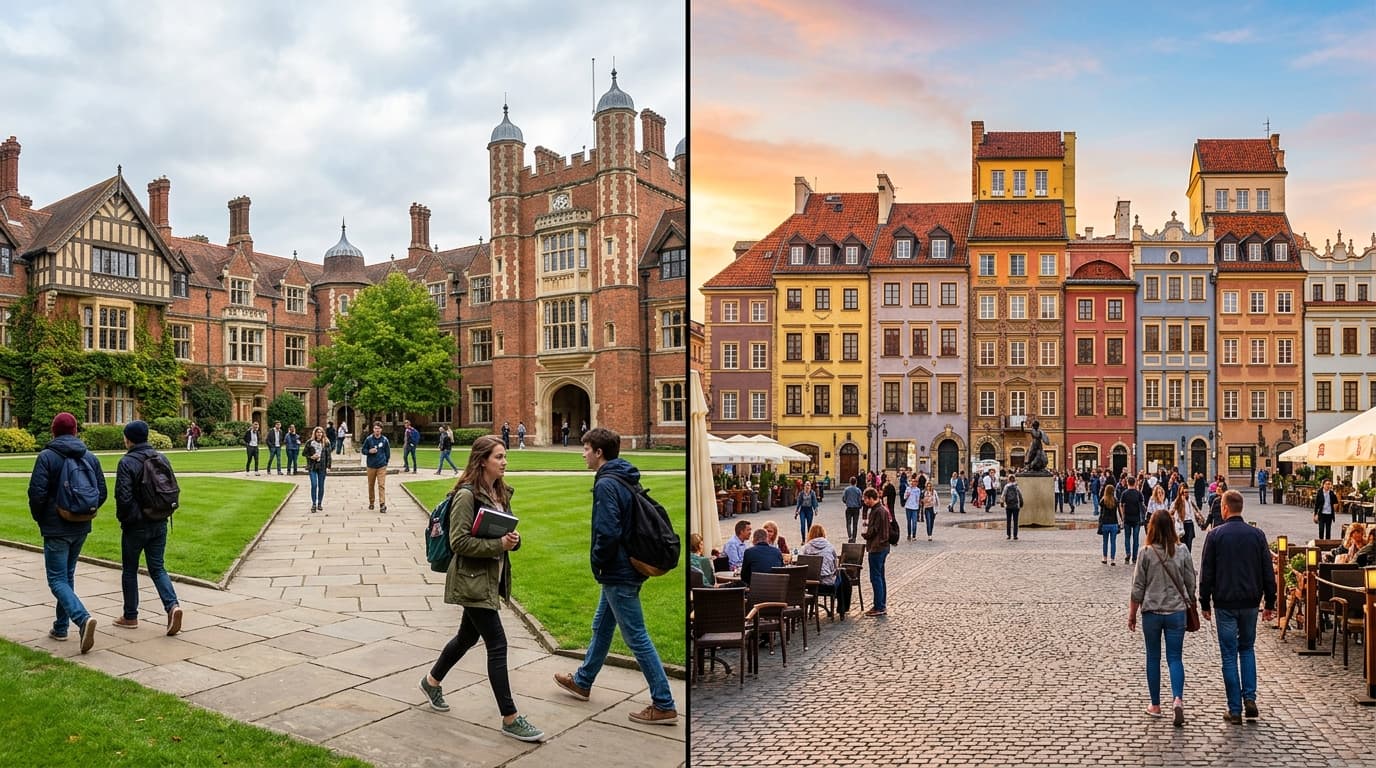
Priya is an example student from Manchester weighing a business degree at home against Warsaw. The comparison page shows both routes in pounds, month by month during study and then at graduation.
- Manchester: a degree plus roughly 30,000 pounds of fee borrowing, repaid at 9% of everything above 25,000 pounds until cleared or written off after 40 years.
- Warsaw: a degree plus 15,000 euros of tuition and three years of living costs already paid, and nothing owed.
Which pattern fits depends on what a household can fund now and what the student expects to earn later.
See the full comparison: staying home against Warsaw, for a student from England
Every fee and repayment figure here comes from the government's published student loan terms and the universities' own fee tables, checked on the dates listed on the comparison page. Fees, thresholds and exchange rates change; verify any figure that matters to your decision on the primary source before acting.