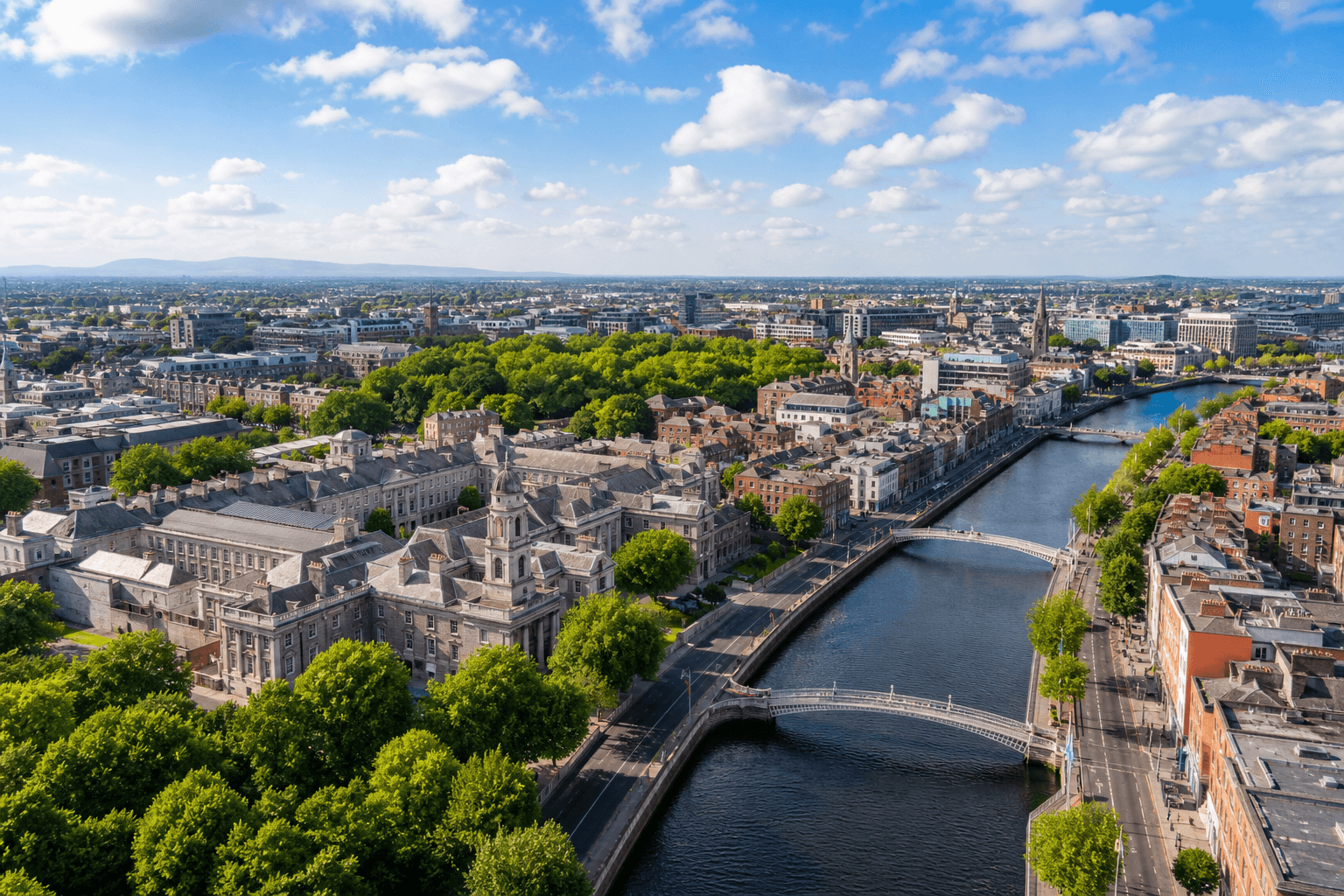
Ireland occupies a unique position in European higher education: it is the only EU country where English is the first language of daily life. For international students who want a degree taught entirely in English, access to EU-wide graduate pathways, and an international campus environment, Ireland offers a combination that nowhere else in Europe can match.
It comes at a price. Ireland is among the more expensive study destinations in Europe for non-EU students, and the Dublin accommodation market is one of the most competitive on the continent. But for the right student, the trade-offs are clear.
Why Ireland?
Ireland has four universities in the QS 2026 World University Rankings top 300. Trinity College Dublin ranks 75th globally, UCD ranks 118th, UCC ranks 246th, and University of Galway ranks 284th. Dublin City University ranks 410th. For the first time, all Irish universities now sit in the world's top 800.
The country's English-medium instruction is a genuine differentiator. Students from Asia, the GCC, and the UK do not need to learn a new language to live, study, and work in Ireland. All official communication, every lecture, every assessment, and every workplace interaction happens in English. That is not true of France, Germany, the Netherlands, or any other European destination where a local language sits alongside English instruction.
Ireland is a full EU member. Degrees are awarded under the European Qualifications Framework, recognised across all 27 member states. The country has established itself as a European hub for technology, pharmaceuticals, and financial services - Apple, Google, Meta, Microsoft, and Pfizer all have European headquarters in Ireland. For students targeting careers in these sectors, the professional networks available from Irish campuses are valuable.
Important: Undergraduate applications for EU-fee-status applicants go through the CAO (Central Applications Office); most non-EU applicants apply directly to each university instead. Postgraduate applications go directly to individual universities or through the Postgraduate Applications Centre (PAC). Planning timelines and deadlines differ substantially between the routes.
What Does It Cost?
Tuition Fees
EU and EEA students studying at Irish public universities at undergraduate level pay no tuition fees - the Higher Education Authority (HEA) grant covers fees. All students, including EU nationals, pay the Student Contribution Charge of EUR 2,500 per year (reduced from EUR 3,000 from January 2026).
Non-EU international students pay full tuition. Fees at public universities for 2025-26:
- Non-EU undergraduate: EUR 9,000-25,000 per year, depending on institution and subject
- Non-EU postgraduate (taught Master's): EUR 10,000-32,000 per year
Sciences, engineering, data science, and business sit at the top of these ranges. Humanities and social sciences sit at the lower end. Medicine and veterinary science are a separate category - fees of EUR 40,000-65,000 per year apply, and places are extremely limited for non-EU students.
Pitfall: The Student Contribution Charge is separate from tuition fees and applies to all students including EU nationals. Budget EUR 2,500 per year on top of your tuition figure.
Living Costs
Ireland is expensive to live in, and Dublin is among the highest-cost student cities in Europe. Typical monthly costs:
- Dublin: EUR 1,200-1,800 per month
- Cork, Galway, Limerick, Waterford: EUR 900-1,300 per month
Accommodation is the single largest cost and the single largest stress for students arriving in Ireland. Purpose-built student accommodation in Dublin costs EUR 800-1,400 per month for a single room. Private rentals outside student accommodation are difficult to secure - the Irish rental market is severely supply-constrained.
Pitfall: Do not arrive in Dublin expecting to find accommodation once you get there. Apply for on-campus or purpose-built student accommodation as early as your institution allows - typically from the day you receive your offer. Cork, Galway, Limerick, and Waterford offer substantially better accommodation availability and lower rents while still providing high-quality institutions.
Scholarships for International Students
Government of Ireland International Education Scholarships (GOI-IES)
The GOI-IES is Ireland's flagship scholarship for international students. In 2026, 60 scholarships are awarded for one year of full-time postgraduate study. Each scholarship provides a full tuition fee waiver plus a EUR 10,000 annual stipend toward living costs.
Eligibility: non-EU, non-EEA, non-Swiss, non-UK nationals only. You must hold a conditional or final offer of admission to a Master's, postgraduate diploma, or PhD programme from an eligible Irish institution at the time of applying. The 2026 call closed 12 March 2026; for 2027 entry, expect applications to open in January and close in March.
Note: GOI-IES does not cover Bachelor's study. University-specific scholarships and partial fee waivers are the main route for undergraduate students.
University-Specific Scholarships
Trinity College Dublin, UCD, UCC, and University of Galway all run dedicated international scholarship programmes. Awards vary from EUR 2,000-5,000 partial fee reductions to full fee waivers at the most competitive level. Check the international admissions pages of your target institutions directly - most require a separate application after receiving your offer.
Science Foundation Ireland and Irish Research Council Awards
SFI and the Irish Research Council (IRC) fund PhD studentships in research institutions across Ireland. These are awarded to research projects - contact prospective supervisors directly and ask about funded PhD positions. A funded PhD covers fees and provides a living stipend, typically EUR 18,000-22,000 per year.
How to Apply
Undergraduate: CAO
Undergraduate applications with EU fee status go through the CAO (Central Applications Office) at cao.ie. Registration opens in early November for the following September intake, with the normal closing date of 1 February. You can list up to 10 Level 8 (honours degree) choices, ranked in genuine preference order. Non-EU applicants usually do not use the CAO: Trinity requires a direct application per course (EUR 55 fee, final deadline 30 June, priority 1 February) and UCD takes direct applications on a rolling basis - check each university's international admissions pages for its own route and deadlines.
For IB applicants, a score of 30-36 is typical for entry to science and business programmes at the main universities; 35-40+ for medicine. Check each institution's published international entry requirements - the CAO process is designed around the Irish Leaving Certificate, so contact the international admissions office directly to confirm how your qualifications are assessed.
Postgraduate: Direct or PAC
Most taught Master's and PhD applications are submitted directly to individual universities. Some institutions also participate in the Postgraduate Applications Centre (pac.ie). Competitive programmes in data science, business, and law at Trinity and UCD may have rolling deadlines closing from December onward. Documents typically required: undergraduate degree and transcripts, language certificate (if applicable), two academic references, personal statement, CV.
Language Requirements
All teaching in Ireland is in English. Most universities do not require an English language test from students who have completed their prior education in English. For students who have not been educated in English: IELTS 6.0-6.5 Academic or TOEFL iBT 79-90 is the standard requirement. Some competitive programmes at Trinity or UCD require IELTS 6.5-7.0.
Student Visa and Residence
Visa Requirement
Students from countries in the visa-required category (including India, Pakistan, most African and Asian nations) must apply for a student visa before travelling. Students from the UK, EU, and EEA do not require a visa.
Financial Proof
For a one-year course, you must demonstrate access to EUR 10,000. The funds should be in your own account; if a parent or sponsor is providing the funds, a notarised sponsorship letter plus their six-month bank statements are required. A large unexplained lump sum deposited immediately before applying is a common reason for refusal.
The same financial standard applies when you register your immigration permission after arrival: since 30 June 2025, students on a course of an academic year or longer must show EUR 10,000 for the first year, with evidence of similar funds for each later year; for shorter courses of six to eight months the requirement is EUR 833 per month (the old EUR 3,000 registration figure no longer applies). Open an Irish bank account promptly after arriving.
Stamp 2 - Work Rights
Once in Ireland, non-EU students hold Stamp 2 immigration permission and can work:
- During term time: 20 hours per week maximum
- During holiday periods (June, July, August, September; 15 December to 15 January): 40 hours per week
Post-Study Work - Stamp 1G
After completing a degree at Level 8 or above at an Irish institution, non-EU graduates can apply for Stamp 1G (Third Level Graduate Programme), which allows full-time work without a separate employer-sponsored work permit.
- Level 8 (Honours Bachelor's degree): 12 months
- Level 9 (Master's) or Level 10 (PhD): 24 months (issued as 12 months, renewable once)
- Fee: EUR 300
If you secure employment with a registered Irish employer, you can apply to convert to a General Employment Permit or Critical Skills Employment Permit depending on your salary and role.
Pitfall: Stamp 1G runs from the date your permission is issued, not your graduation date. Apply promptly - do not let months pass after graduating.
Top Universities for International Students
- Trinity College Dublin - Ireland's oldest and most internationally recognised university. QS 2026 rank: 75th. Strong in law, medicine, sciences, humanities. Dublin city centre campus.
- University College Dublin (UCD) - Largest research university in Ireland. QS 2026 rank: 118th. Over 11,000 international students from 130+ countries.
- University College Cork (UCC) - Strong in sciences, food and nutrition, law. QS 2026 rank: 246th. More affordable accommodation than Dublin.
- University of Galway (formerly NUI Galway) - Sciences, medicine, arts. QS 2026 rank: 284th. Smaller city, lower living costs, strong cultural identity.
- Dublin City University (DCU) - Business, engineering, computing, communications. QS 2026 rank: 410th. Growing international profile.
- University of Limerick (UL) - Engineering, science, arts and education. Strong cooperative education model. Most affordable major Irish city for students.
Practical Tips
Accommodation - start immediately. Register for on-campus accommodation the day you receive your offer. The Dublin market moves faster than anywhere else in Europe.
Health insurance is required for non-EU students. Ireland's public health system (HSE) is not freely available to non-EU students. Most universities have arrangements with private health insurance providers - check your institution's requirements before you arrive. Budget EUR 500-700 per year.
PPS number - your Personal Public Service number is Ireland's national tax and social services ID. Apply for it at a local INTREO office in your first week. You need it to work legally, open some bank accounts, and register with the HSE.
Leap Card - Ireland's national transport card works on buses, Luas (Dublin tram), and DART (Dublin suburban rail). Students get discounted fares.
Bank account - open an Irish bank account promptly after arriving. You will need to show proof of funds (EUR 10,000 for stays over eight months) at immigration registration. N26, Revolut, or Bank of Ireland student accounts are common choices.
Is Ireland Right for You?
Ireland is the clearest choice in Europe if English-medium instruction is non-negotiable and you want an EU degree and EU-facing career pathways. No other European country offers that combination.
The challenges are real: tuition fees for non-EU students are among the highest in Europe, the Dublin accommodation crisis is genuine, and health insurance adds a cost that students at French, German, or Polish universities do not face.
Against that, Ireland offers a 24-month post-study work window for Master's and PhD graduates, a professional ecosystem anchored by major technology and pharmaceutical employers, and the EU's most fully English-speaking campus environment.
If you are comparing Ireland against other European destinations: it is more expensive than France, Germany, the Netherlands, or Poland on both tuition and living costs. The post-study work provision is comparable to France and stronger than most Central European alternatives.
Use the Sophyra Next Affordability Planner to compare total costs between Ireland and your other shortlisted destinations, or explore your full options with the Best-fit Study Options tool.